Sunday, October 29, 2017

'Tolls abolition no silver bullet, for BN or Pakatan', The Malaysian Insight, 29 October 2017


Sheridan Mahavera Low Han Shaun Tolls abolition no silver bullet, for BN or Pakatan
Come January, motorists will no longer have to pay toll at the Batu Tiga and Sungai Rasau plazas on the Federal Highway. – The Malaysian Insight pic by Hasnoor Hussain, October 29, 2017.,
      
THE feel-good sentiment arising from the abolition of toll at selected highways is unlikely to translate into votes in the general election, say political analysts.
In the reading of Budget 2018, Prime Minister Najib Razak announced that come January, toll would not longer be collected at the Federal Highway’s Batu Tiga and Sungai Rasau plazas, at the northern Bukit Kayu Hitam toll plaza in Kedah en route to Thailand, and on the Eastern Dispersal Link (EDL) from Tebrau to the Customs and Immigration Complex in Johor Baru.
While Barisan Nasional leaders are positive the goodies packaged in next year’s national budget will tip the scales in their favour in the 14th general election, political observers are less optimistic.
History shows that ruling political parties have abolished tolls only to still get kicked out in elections, says independent pollster Ibrahim Suffian.
Tan Siew Kuan, a daily commuter to Klang who will benefit from the cessation of toll collection, said he was realistic to know that payment would be exacted in one way or another.
"Sure the abolishment of the Batu Tiga toll will help to ease my pocket, but if you extend the terms of the tolls on the other highways, we are already paying for it anyway,” said the crane operator who works in Port Klang.
"I'm not happy about the abolishment of the toll nor am I angry about it. Toll or no toll you still get stuck in a traffic jam anyway.”
Ibrahim said that in the end, whether the discontinuation of selected tolls would have an impact on the polls for BN and even Pakatan Harapan would depend on a host of other factors.
These include party machinery and preparedness,  the electoral boundary redelineation, and race and religious sentiment, he said.
“By itself, it cannot win elections. It is only one tool in a toolbox,”
said Ibrahim, executive director of opinion research firm Merdeka Center.
Battleground states
BN Cabinet ministers have high hopes that the budget would shore up support for the ruling coalition in what many say will be a challenging general election, which must be called by August next year.
“The prime minister himself said the budget was strategic in its focus on different groups and areas,” said political scientist Prof Sivarmurugan Pandian of Universiti Sains Malaysia.
The new tolls policy goes hand-in-hand with tax breaks for the middle class and both are meant to woo urban voters, he said.
It is no coincidence that the tolls have been abolished in Selangor, Johor, and Kedah – battleground states where BN is anticipating an onslaught by the opposition coalition.
In Selangor and Johor, the highway snakes through Tebrau, Pasir Gudang, Johor Baru, Shah Alam, and Kelana Jaya – urban parliamentary seats that will be hotly contested for in the polls.
In the last election, BN retained Tebrau and Pasir Gudang with
majorities of below 2,000 votes.
Ibrahim does not believe that the termination of tolls will have a large impact on support for BN despite the money it will save for voters.
“At the end of the day, it’s incremental. You’re giving people back RM2 per day. It may bring back some support but is it enough to recoup the support that was lost after the (GST)?”
There is also the historical precedent of the 1999 Terengganu PAS government to consider when it comes to using toll as an election carrot.
“The Terengganu PAS government abolished toll for the Kuala Terengganu bridge. It was an extremely popular move. But in 2004, they still lost the state government due to other issues.”
The Terengganu PAS lesson should be a cautionary tale not just for BN, but also PH.
The opposition pact has been quick to pounce on BN’s promise, claiming that the ruling coalition was yet again copying its policies.
In its alternative budget unveiled two days before BN’s, PH said it aimed to abolish all highway tolls in five years by reviewing and renegotiating concession agreements.
“PH’s promises are coming in at a time when people are tuning out of politics and are sceptical of promises, especially from the opposition because they are not in power,” said Ibrahim.
Tolls and the GST were "big ticket" lures, said Ibrahim, which had voters asking if PH would be able to fulfil its pledges.
Sivamurugan argues there is no guarantee that the overall budget will translate into votes as much still depended on delivery and implementation.
“The election is still a way off and by the time it hits, people will be concerned about other issues. To what extent the budget will translate into votes is hard to say.
“The next five months will determine that.” – October 29, 2017.

Monday, October 23, 2017

'Budget Can Be A Boon For BN', New Straits Times, 23 October 2017


'Youth Disenchanted With Pakatan Harapan, Say Analysts', New Straits Times, 21 October 2017


Curtain Raiser For Amanah National Convention', The Sun Daily, 21 October 2017

ALOR STAR: As some 900 delegates gather for the annual convention of one of the country's youngest political parties, lingering questions have emerged about the durability of Parti Amanah Negara (Amanah).
Since its formation in 2015, the splinter party of the Islamist driven - PAS, has raised more doubts rather than conviction about its ability to become a full-fledged party rather than one dependent on their Pakatan Harapan partners of PKR, DAP, and Parti Pribumi Bersatu Malaysia.
The doubts about the ability of Amanah to be a potent force against PAS, are real as they have been tested in recent months, said political scientist Prof Dr. Sivamurugan Pandian.
However, they have failed to rise to the occasion, said the Universiti Sains Malaysia's academician.
He cited the first example at the party's losses at the twin parliamentary by-elections in Sungai Besar (Selangor) and Kuala Kangsar (Perak) last year.
Both seats were won by ruling coalition Barisan Nasional (BN).
"Amanah had a chance to prove its relevance. Instead, it raised more questions on whether the electorate can accept a PAS splinter party."
Secondly, Sivamurugan pointed out that Amanah had failed to garner strong grassroots numbers for the various public rallies that Pakatan has organised in the past two years.
While there are crowd numbers, the figure is not telling as in the era of 2008 to 2013 where BN was seen as backpedaling, he pointed out.
Thirdly, Amanah's political ideology is vague compared to their main rival - PAS, who has clearly outlined that their struggle is for an Islamic state (nation) as well as the larger adoption of the Syariah legislation.
"PAS is all about Islam. It has been their root cause and calling card since their inception. Amanah is neither here nor there when it comes to where they should stand," said Sivamurugan.
Therefore, he sees Amanah's struggle as an uphill task to dislodge PAS.
According to him, Amanah needs to do more to stand up to the adversaries such as PAS.
Or, then many dependent on PKR or Bersatu to contest in the nearing 14th general election.
Many pundits also concurred that if multiple cornered fights surface in Amanah seats, the party may be on the receiving end.
It was reported that Amanah was eyeing up to 40 parliamentary seats.
Kelantan Amanah adviser Datuk Wan Abdul Rahim Wan Abdullah, however, believed that change is in the air for the country.
Due to the blunders and perceived corrupt practices of BN, Wan Rahim, who is affectionately referred to as "Cikgu Rahim", believed that Amanah may be able to deliver in Kelantan.
"Kelantanese has proven that they are unafraid of change. In 1959, they voted in PAS; in 1978, they went with BN and in 1990, they went back to PAS. It is not an impossible task for Pakatan to win handsomely."
He said that he was confident that Kelantan Amanah under the leadership of its chairperson Datuk Husam Musa can compete with PAS, especially in view that the latter has leaders, who are unimaginative.
Despite the contention of multiple cornered fights, Cikgu Rahim believed that the voters' maturity will prevail.
They will rather side with those, who have a chance to win rather than based on sentiments.
"When there is an overkill on politics; voters tend to cast aside sentiments and use their wisdom to decide on what is best for them."

'PAS Bimbang Sokongan Rakyat', Sinar Harian, 17 Oktober 2017


Move On, Pundits Tell Pakatan After Apathetic Anti-kleptocracy Rally', The Malay Mail Online, 16 October 2017

KUALA LUMPUR, Oct 16 — Pakatan Harapan (PH) should offer its alternative policies on living cost issues instead of harping on 1Malaysia Development Berhad (1MDB) in its rallies, political observers said.
Addressing the lukewarm turnout at the Opposition’s anti-kleptocracy rally last Saturday, the analysts suggested the federal Opposition pact would likely gain more traction by switching gears and focus on policy matters rather than continue the blame game.
“[The poor turnout at the rally] signals that the pact cannot ride on 1MDB alone,” Penang Institute’s Ooi Kok Hin told Malay Mail Online.
“They have to offer a coherent alternative, a radical new narrative and paradigm shift,” he added.
Like Ooi, Oh Ei Sun also said PH should talk about things the coalition can offer if it won federal power.
“People are impotent to do anything about 1MDB, hence a sense of resignation sets in. They could instead talk about better times after GST is repealed,” the adjunct senior fellow at the S. Rajaratnam School of International Studies in Singapore said.
But the political analysts also cautioned against using the turnout at rallies as a gauge of public support.
Sivamurugan Pandian, an analyst with Universiti Sains Malaysia, said the lower than expected crowd at the rally might have created a dilemma for PH, but cannot be used as a yardstick of its voter support.
“We cannot generalise or make this as a yardstick to measure support among the Opposition,” he said.
Oh also concurred that a large turnout at rally does not guarantee votes during elections.
“But small turnout usually indicates apathy in general,” he said.
Organisers of the rally had initially projected a turnout of 30,000 people, which they later lowered to 10,000 in the week ahead of the gathering.
Their much-touted evening assembly at Padang Timur in Petaling Jaya, Selangor last Saturday only drew an estimated 5,000 plus people at its peak. Also noticeable then was the number of older people compared to those in their 20s attending the gathering, a stark contrast to previous rallies such as the Bersih protests.
PH chief secretary Datuk Saifuddin Abdullah acknowledged the anti-kleptocracy rally this round had relatively less youths and said his side will “studiously” look into the matter.
Saifuddin said several questions must be raised on this and among others, he added, include the relation between poor youth turnout and the high number of unregistered young voters and whether they preferred streaming the rally from the social medias than going down to the ground.

Read more at http://www.themalaymailonline.com/malaysia/article/move-on-pundits-tell-pakatan-after-apathetic-anti-kleptocracy-rally#6KxDmYRQY4GWldJ3.99

'Politically Passive': 3.7m Youths Yet To Register As Voters, New Straits Times, 15 October 2017


KUALA LUMPUR: LESS than half of the six million people expected to register as voters after the last election will be on the next electoral roll.
Until July this year, 3.7 million people, mostly youth aged between 21 and 30, have yet to join the ranks of the 14.6 million voters.
The impact may vary in the long run, but the issue needs to be addressed to ensure Malaysia continues to progress as a democratic nation.
Election Commission (EC) chairman Tan Sri Mohd Hashim Abdullah said there were five factors for them not exercising their democratic right.
These were the belief that the polling system was not in line with religious concepts, ignorance of the importance of voter registration, preference to voice their sentiments through social media or demonstrations instead of the ballot box, political fatigue, and lack of awareness about registration facilities, he said.
There are also those influenced by certain parties to paint the commission as allegedly corrupt or partisan, although such an issue is not a major factor.
“Such (negative) views about the EC are part of the propaganda by certain parties. All of them are not true,” Hashim said.
In his recent blogpost on sskeruak.blogpost.com, Umno treasurer Datuk Seri Salleh Said Keruak said explanations had to made to the young to correct their perception about politics and to stop them from remaining politically passive.
Salleh said he was sad that the statistics showed many who did not register as voters were 21 years old.
“I think it’s a loss if young people are politically passive.
“If their non-interest in politics is the factor, then their perception (about politics) needs to be corrected.
“Young people cannot go on like this as they will be the ones charting the country’s future.
“There is still time and the young need to be motivated to register as voters,” he said.
Salleh quoted the Merdeka Centre survey, which found the young being politically passive due to a number of factors, including being busy with work, fed up with the political games of the elders, distrust of politicians, and the feeling that voting would bring them no benefit.
“Another study by researchers from Universiti Kebangsaan Malaysia revealed the shocking factor of young people’s interests being neglected by politicians and their confusion over the political situation.
“They don’t trust the country’s political institutions. ‘
“They are fed up. Thus, the above views should be given attention.”
He urged political parties to campaign to get the young to be politically active because the country needed them for its future success as “young souls are strong, energetic and visionary”.


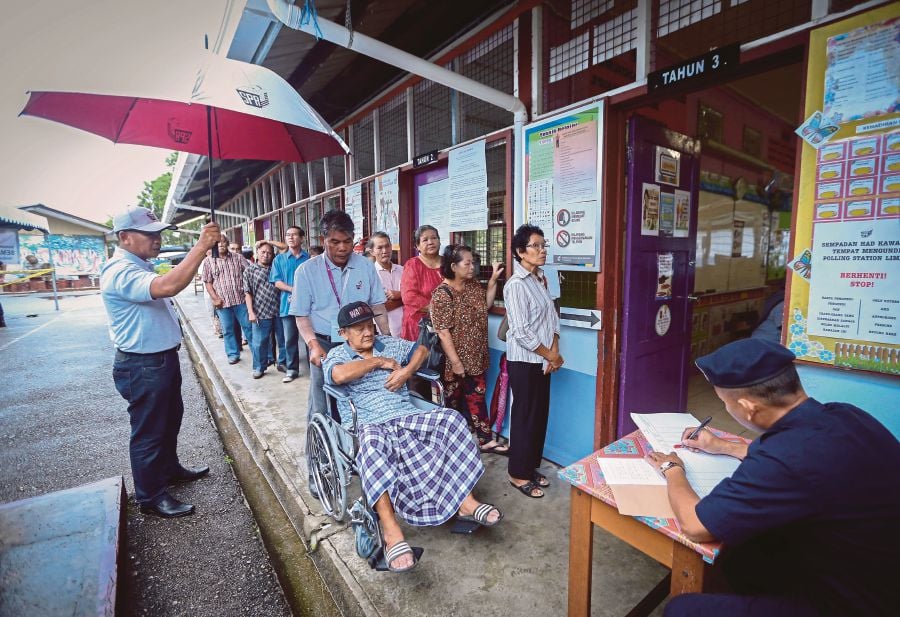
(NST File Pix) Voters lining up to exercise their electoral rights at the Tanjung Datu by-election in Sarawak in February.

Political expert Professor Dr Sivamurugan Pandian agreed that such was the long-term issue often overlooked and the setback lay in ratio imbalance between voters in neighbouring polling constituencies.
If people continue to disassociate themselves from the electoral process, the results could be just a collective waste of opportunities in charting the country’s path.
“The last redelineation was carried out in 2003, and another should have been implemented in 2013.
“However, the EC said the exercise in 2013 could not take place as the 13th General Election was just around the corner.
“The redelineation is now overdue and we have to implement it as soon as possible to fit into our geographic and demographic changes.”
Theoretically, the imbalance would lead to constant redelineation exercises and a split in voter bases.
“Certainly, (an imbalance will take place) as it depends on which constituency registers the most voters.
“And it is not just about numbers. The whole spectrum includes imbalance among gender and socioeconomic groups.
“The latter is particularly important to determine the background of voters, whether they are from the upper, middle or lower-income groups.”
The late United States president Grover Cleveland once said: “Your every voter, as surely as your chief magistrate, exercises a public trust.”
Cleveland, who was the US’s 22nd and 24th president, was expounding on the mandate given by the masses to their elected representatives.
The low number of voters due to non registration could mean the results are not a reflection of the majority’s wishes.
Hence, the low number of registered voters could easily lead to a question on the legitimacy of winning parties, Professor Dr Azizuddin Mohd Sani said.
“Ideally, the party that wins and fulfils the requirement to form the government, by and large, has received the mandate and is endorsed by eligible voters to set the direction of the state or country.
“If only less than 50 per cent of eligible voters turn up, then there will be a question of legitimacy. Regardless of which party wins and forms the government, do they truly represent the people’s confidence and wishes?”
Sivamurugan said democracy could only be realised through mass participation of the people, and it was a right exercised by mature nations.

“If you do not participate in one of the main pillars of the country’s democratic system, then you are losing your right to decide the type of government you want.
“One can always say that there is no guarantee that a registered voter will cast the ballot paper on polling day, but those who did not register will certainly not vote.”


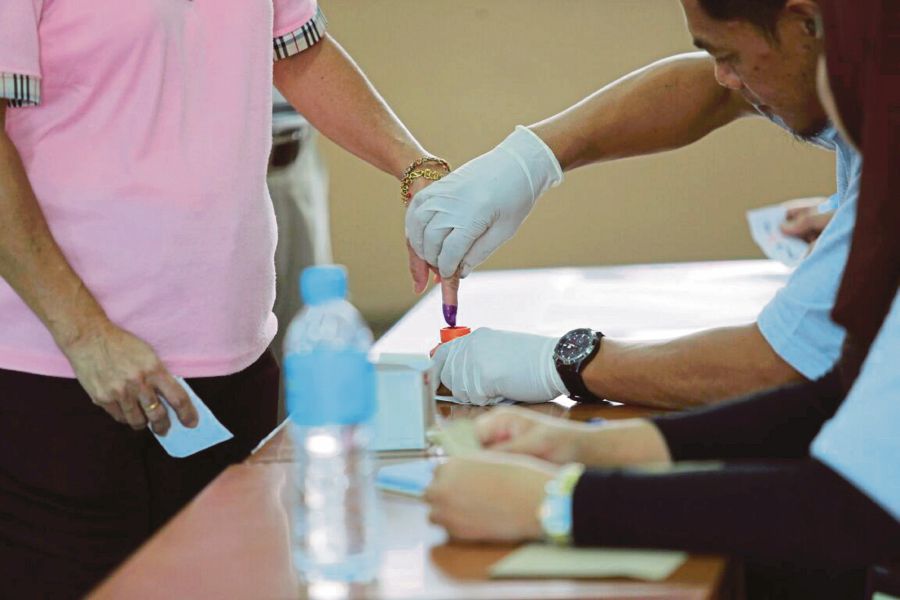
(NST File Pix) A citizen has the right to vote and participate in the conduct of public affairs through the ballot box.

Business consultant Mark Looi, 34, believes that people play a large role in determining the country’s future.
Looi, from Petaling Jaya, puts his faith in the democratic system, without veering too much into the political bedlam that colours most of the media headlines today.
“I look into the policies adopted by the government. For me, as a voter, that is the main factor to be considered before I reach a decision.
“I do not really look into political sentiments.
“The government with the best policies in managing the country and its people gets my vote.


“As voters, we care about our nation and future.
“Voting is the most direct way for a citizen to express political preference.
“Rather than spending time simply making noise (talking about political issues or sentiments) or attending political rallies, it is better to support your stand by voting.”

Tuesday, September 19, 2017

'Pilihan raya tahun depan? Selepas Umno satukan Melayu' The Malay Mail Online, 19 September 22


Datuk Seri Najib Razak berucap di perhimpunan agung Umno pada 2015. Beliau dijangka mengadakan pilihan raya umum selepas perhimpunan tahun ini. — Foto Bernama© Provided by Trinity Diligent Sdn Bhd Datuk Seri Najib Razak berucap di perhimpunan agung Umno pada 2015. Beliau dijangka mengadakan pilihan raya umum selepas perhimpunan tahun ini. — Foto…SERDANG, 19 Sept — Pilihan raya umum ke-14 (PRU 14) dijangka tidak berlangsung sehingga selesai perhimpunan agung Umno (PAU).
Seorang pensyarah Universiti Sains Malaysia berkata PAU menjadi medan terpenting menyatukan ahli Umno supaya tidak berlaku undi protes nanti.
“PAU harus diguna untuk mendapatkan barisan yang kukuh pada Disember nanti. Sebelum PRU13 hanya tiga parti orang Melayu iaitu PAS, PKR dan Umno.
“Tetapi kini bertambah dua iaitu Parti Pribumi Bersatu Malaysia (PPBM) dan Parti Amanah Negara (Amanah) yang boleh memecahbelahkan undi Umno,” kata profesor Dr Sivamurugan Pandian.
Dr Sivamurugan berkata sabotaj perlu diminimumkan supaya Umno boleh berdepan dengan masalah lain. — Foto oleh Zulyana Rahman© Provided by Trinity Diligent Sdn Bhd Dr Sivamurugan berkata sabotaj perlu diminimumkan supaya Umno boleh berdepan dengan masalah lain. — Foto oleh Zulyana Rahman PRU14 perlu diadakan selewat-lewatnya Ogos tahun depan, namun pemerhati berpandangan ia mungkin diadakan akhir tahun ini atau awal tahun depan.
PAS, tidak bersama Pakatan Harapan (PH), menyebabkan undi Melayu khususnya pembangkang berpecah dalam persaingan tiga penjuru dengan Barisan Nasional.
Perdana Menteri Datuk Seri Najib Razak sebelum ini menyatakan kesediaan untuk mengadakan PRU pada bila-bila masa melihat perselisihan dalam PH.
Sivamurugan berkata selain PAU yang menjadi medan menyatukan ahli Umno, rakyat terbanyak juga ingin merasai insentif dalam Bajet 2018.
Katanya, apa yang lebih penting adalah PAU itu sendiri yang akan memberi peringatan kepada ahlinya untuk tidak mensabotaj parti dalam PRU 14.
“PAU itu penting untuk mengelak perpecahan undi Melayu. Ahli Umno perlu disatukan bagi mengelak undi protes dan apakah agenda untuk orang Melayu sendiri.
“Sabotaj perlu diminimumkan supaya Umno boleh berdepan dengan masalah lain.
“Kalau masalah dalaman sukar untuk diatasi bagaimana untuk bersama mengatasi pembangkang,” katanya lagi. Dr Arnold Puyok berkata rakyat tidak melihat isu kabotaj tetapi kesan langsung daripada GST. — Foto oleh Zulyana Rahman© Provided by Trinity Diligent Sdn Bhd Dr Arnold Puyok berkata rakyat tidak melihat isu kabotaj tetapi kesan langsung daripada GST. — Foto oleh Zulyana Rahman
Pensyarah Universiti Malaysia Sarawak (Unimas) pula berpandangan kerajaan perlu menangani isu kenaikan kos sara hidup di Malaysia Timur menjelang PRU 14.
Dr Arnold Puyok berkata isu itu penting kerana pengecualian dasar kabotaj di dua negeri itu tidak memberi kesan kepada penurunan harga barang.
“Ada pihak mendakwa kenaikan harga bukan disebabkan kabotaj tetapi disumbang beberapa faktor lain. Perdebatan ini masih berterusan. 
“Keluhan yang kita dengar harga barang dan harga minyak semakin naik. Ini menimbulkan keresahan rakyat.
“Rakyat tidak melihat isu kabotaj tetapi kesan langsung daripada cukai barangan dan perkhidmatan (GST),” katanya.

Monday, September 18, 2017

'Kemasukan Semula Mat Taib Strategi UMNO Rampas Balik Undi - Dr Sivamurugan', Awani, 18 September 2017


Kemasukan semula Mat Taib strategi UMNO rampas balik undi - Dr Sivamurugan
Penerimaan masuk Bekas Menteri Besar Selangor, Tan Sri Muhammad Muhamad Taib ke dalam UMNO semula merupakan strategi parti itu merampas semula undi dari parti pembangkang.
KUALA LUMPUR: Penerimaan masuk Bekas Menteri Besar Selangor, Tan Sri Muhammad Muhamad Taib ke dalam UMNO semula merupakan strategi parti itu untuk merampas semula undi dari parti pembangkang.

Demikian pandangan Pensyarah Pusat Pengajian Sains Kemasyarakatan Universiti Sains Malaysia, Prof Dr Sivamurugan Pandian, yang menyifatkan langkah itu sebagai usaha yang cuba dilakukan oleh Barisan Nasional dan UMNO untuk memberi nilai tambah kepada kedudukan serta persaingan parti itu di Selangor.

“Apabila beliau keluar dari UMNO, barangkali itu merupakan usaha untuk mengkaji pemikiran pengundi Melayu yang pernah bersama dengan Pas, PKR dan UMNO dan juga bagaimana beliau boleh melahirkan keyakinan ke arah itu,” katanya kepada Astro AWANI.
Beliau juga tidak menafikan bahawa kehilangan Muhammad atau 'Mat Taib' akan memberi impak kepada Pakatan Harapan kerana beliau pernah bersama dua parti besar di Selangor.


“Apatah lagi pada tahun 2013, analisis menunjukkan bahawa kemasukkan beliau dalam Pakatan Harapan membolehkan Pas mengunakan kehadiran beliau untuk mempengarahui pengundi Melayu yang melakukan undi protes terhadap UMNO.

“Itu juga cabaran Muhammad  bagaimana beliau boleh kembalikan sokongan yang hilang dari UMNO,” katanya.

Tambahnya, Pakatan Harapan juga mempunyai cabaran bagi mencari pengganti Mat Taib yang mempunyai peranan yang penting untuk kedudukan dalam Selangor.

'Latest Exits Show Wheels Coming Off For PPBM, Observers Say', Malay Mail Online, 18 September 2017


BY KAMLES KUMAR
September 18, 2017

KUALA LUMPUR, Sept 18 — Two high-profile resignations at Parti Pribumi Bersatu Malaysia belies its professed ambition of challenging Umno, according to political observers.
Noting that the resignations were just the latest involving former Umno leaders who joined during PPBM's formation a year ago, Dr Oh Ei Sun said the party has remained in a flux despite the general election being under a year away at most.
PPBM still lacked a foundation upon which to build and the exit of two founding members revealed that the party was never united from the beginning, he explained.
"It (PPBM) was never stable, with people coming in and out as it suits their political agenda of the moments," he told Malay Mail Online when contacted yesterday.
The senior fellow at the S. Rajaratnam School of International Studies in Singapore added that the party also lacked cohesion save for the façade put up by its top leaders.
PPBM co-founder and former Gopeng Wanita Umno chief Anina Saadudin along with Datuk Hamidah Osman announced their resignations on Saturday, joining another founding member, Datuk Khairuddin Abu Hassan, who departed earlier.
Universiti Sains Malaysia political analyst Dr Sivamurugan Pandian said the two departures suggest that PPBM lacked the support to be a meaningful contender in the general election, especially after losing vital women leaders.
PPBM must also rebuild public trust in its capabilities and ideology, he said when noting that the party was now dependent on the cult of its senior leaders' personalities.
"The party is newly formed and they need more time to structure and position themselves. but then time might not be with them as GE is around the corner,” he said.
Universiti Utara Malaysia associate professor Dr Mohd Azizuddin Mohd Sani pointed out that with a similar structure to Umno, PPBM was likely reliant on its women's wing to carry out the necessary groundwork for the coming polls.
For Umno, the Wanita wing is the backbone of its election machinery and its thousands of members are vital in swaying opinions of households towards the Malay nationalist party.
Azizuddin noted that PPBM would have lost any remaining vestige of this with Anina and Hamidah's exit.
"They would lose especially in the war of perception. It would be difficult for them now, the woman machinery is no more.
"Any good perception the party among the women voters is now gone," he told Malay Mail Online.
Commenting on the party's viability for the next general election, the analysts believed the party lacked capability except at the very top, in the form of Tun Dr Mahathir Mohamad and Tan Sri Muhyiddin Yassin.
Banking on Dr Mahathir alone to carry the party was also a risky proposition as he was a representation of the country's history rather than its future, they explained.
"He should not consider himself leader of the future. People want to see something new," UUM vice-chancellor Prof Datuk Seri Dr Mohamed Mustafa Ishak said.
He further suggested that the disagreements within PPBM were indicative of fundamental differences regarding its role in the Opposition, where it is allies with DAP, the party most often viewed as the current natural nemesis of Umno.
PPBM also failed to convince its members about its position on key issues, particularly those concerning the Malay-Bumiputera agenda that may not fully dovetail with those of its allies in Pakatan Harapan.
"The collaboration with DAP is one of the major issues. Not all party members agree. Ideology completely is going against DAP," Mustafa explained.


'Dr M Could Decide RCI Outcome', New Straits Times, 18 September 2017


'Experts: Mat taib's Return Good For UMNO', New Straits Times, 18 September 2017


Thursday, September 14, 2017

'Kesepaduan Rakyat Berada Pada Tahap 80 peratus – Ahli Akademik', Bernama, 14 September 2017


SERDANG: Di sebalik pelbagai andaian, tahap kesepaduan rakyat berbilang etnik, agama dan budaya di negara ini sebenarnya telah berada di tahap 80 peratus, demikian kata Prof Ulung Datuk Dr Shamsul Amri Baharuddin.
Timbalan Pengerusi Majlis Profesor Negara (MPN) itu berkata kesepaduan tersebut merangkumi aspek budaya, makanan, pendidikan dan ekonomi.
Beliau berkata perkara itu bagaimanapun seolah-olah tidak diperakui dan disedari ramai serta tidak diberikan perhatian kerana masyarakat hanya tertumpu kepada pencapaian dari segi perpaduan.
Datuk Dr Shamsul Amri Baharuddin
“Kesepaduan biasanya terhasil secara tanpa sedar, contohnya dalam budaya dan makanan yang saling pinjam-meminjam di mana masyarakat secara jelas tidak lagi mempersoalkan ia budaya atau makanan kaum mana.
“Yang menjadi masalah ialah ramai yang tidak mahu mengakui kebenarannya,” katanya yang merujuk kepada dapatan hasil kajian oleh Institut Kajian Etnik (KITA) Universiti Kebangsaan Malaysia (UKM).
Beliau berkata demikian semasa menjadi panel pada dialog Wacana Ilmuan, Negaraku Malaysia: Di Mana, Ke Mana Kita? yang dianjurkan MPN di dewan utama Universiti Putra Malaysia (UPM) di sini semalam.
Dikendalikan oleh Sayed Munawar Sayed Mohd Mustar selaku moderator, dialog itu disertai Ketua Kluster Sejarah, Warisan dan Sosio Budaya MPN Prof Datuk Dr Teo Kok Seong; Setiausaha Kluster Perpaduan Nasional MPN Prof Dr Sivamurugan Pandian; Pengarah Pusat Kepimpinan Wanita Tun Fatimah Hashim UKM Prof Madya Dr Madeline Berma, Prof Madya Dr Awang Asri Awang Ibrahim daripada Universiti Malaysia Sabah (UMS) dan Prof Madya Dr Sarjit Singh Darshan Singh daripada UPM.
Mengenai perpaduan, Shamsul Amri yang juga pengarah KITA berkata aspek itu ada tetapi kewujudannya tidak sekukuh dan seteguh sepertimana yang diharapkan.
Beliau berkata ketika ini perpaduan hanya berlaku dalam masa singkat seperti ketika memberikan sokongan kepada atlet atau pasukan Malaysia yang bertanding dalam sesuatu kejohanan, namun perkara itu tidak terjadi secara menyeluruh dalam semua segmen kehidupan.
Sebab itu, kita perlu perbanyakkan detik-detik perpaduan dalam kalangan masyarakat dan ia boleh terhasil melalui kajian sosial oleh para akademia, katanya.
Dr Sivamurugan turut mempersoalkan sama ada detik perpaduan yang ditunjukkan adalah sesuatu yang ‘palsu’ kerana ia hanya hadir dalam keadaan tertentu tetapi menjadi terlalu sukar untuk diterjemahkan dalam sudut yang lebih luas.
Beliau menekankan mengenai kepentingan bahasa Melayu dijadikan alat perpaduan kerana yakin jika diperkukuhkan, elemen bahasa mampu menjadi ‘senjata’ yang mampu membina negara bangsa yang lebih berjaya.
Sementara itu, seorang panel pemerhati Dr. Arnold Puyok daripada Sarawak berpendapat aspek perpaduan boleh dibina jika satu kempen mengenai kandungan dan kepentingan Perlembagaan negara dipromosikan dengan lebih menyeluruh.
Timbalan Dekan Pascasiswazah dan Penyelidikan Fakulti Sains Sosial, Universiti Malaysia Sarawak (UNIMAS) itu berkata jika Perlembagaan difahami dengan baik, persoalan mengenai hak dan had sesuatu negeri sehingga timbulnya isu seperti “Sarawak for Sarawakian dan Sabah for Sabahan” tidak mungkin terjadi jika pihak yang mencetuskannya memahami dengan baik hak masing-masing.
Isu tersebut sedikit-sebanyak menggoyah perpaduan yang ingin dibina sedangkan ia boleh diselesaikan melalui proses diplomasi berasaskan perkara yang terkandung di dalam Perlembagan, katanya.

'Belum Ada Anak Dihukum Tak Hafal Rukun Negara', Malaysia Gazette, 13 September 2017


Kluster Perpaduan Nasional, Prof Dr. Sivamurugan Pandian berucap pada Wacana Ilmuwan Sambutan Hari Malaysia Majlis Profesor Negara 2017 di Dewan Besar, Pusat Kebudayaan dan Kesenian Sultan Salahuddin Abdul Aziz Shah, Universiti Putra Malaysia (UPM), Selangor. foto HAZROL ZAINAL, 13 SEPTEMBER 2017.

SERDANG – Belum pernah wujud kes di mana ibu bapa menghukum anak-anak mereka kerana tidak menghafal Rukun Negara dan memahami Perlembagaan Persekutuan.
Ahli Jawatankuasa Kluster Perpaduan Nasional Majlis Profesor Negara (MPN), Prof Dr Sivamurugan Pandian berkata, kebanyakan ibu bapa lebih mengutamakan anak-anak mereka menghafal sifir matermatik.
“Kita dipukul kerana tidak menghafal sifir di belakang buku, tapi tidak pernah lagi dihukum kerana tidak menghafal Rukun Negara atau tidak memahami Perlembagaan.
“Yang penting ialah bagaimana peranan keluarga itu mendasari usaha untuk melahirkan sifat atau penyatuan atas negara ini,” katanya dalam Wacana Ilmuan Negaraku Malaysia: Di Mana dan Ke Mana Kita? di Universiti Putra Malaysia (UPM), di sini, hari ini.
Hadir sama Naib Canselor UPM, Prof Datin Paduka Ainis Ideris, dan Presiden serta Ketua Pegawai Eksekutif MPN, Prof Datuk Dr Raduan Che Rose.
Naib Canselor Universiti Putra Malaysia, Prof. Datin Paduka Dr. Aini Ideris (empat kiri) bersama Presiden Majlis Profesor Negara, Prof Datuk Dr. Raduan Che Rose (tengah) bergambar kenangan dengan para panel yang menjayakan program Wacana Ilmuwan Sambutan Hari Malaysia Majlis Profesor Negara 2017 di Dewan Besar, Pusat Kebudayaan dan Kesenian Sultan Salahuddin Abdul Aziz Shah, Universiti Putra Malaysia (UPM), Selangor. foto HAZROL ZAINAL, 13 SEPTEMBER 2017.

Beliau berkata, semangat integrasi bangsa dan kenegaraan itu harus bermula dari rumah dan tidak diserah sepenuhnya kepada pihak sekolah dan rakan sebaya.
“Ia banyak bergantung kepada tanggungjawab yang harus dimainkan oleh pelbagai pihak, bermula daripada keluarga. Apa telah kita bina melalui Perlembagaan dan Rukun Negara merupakan sesuatu harus kita terus pertahankan.
“Ini kerana ini merupakan perkongsian yang telah membolehkan pemimpin 60 tahun lepas adanya kompromi, pengorbanan bahawa tiada pihak boleh mendapat semua dan tidak ada pihak yang harus hilang kesemuanya,” katanya.
Katanya, semangat kenegaraan hanya boleh wujud jika semua pihak boleh mencari titik keseimbangan di antara satu sama lain.
“Proses sosialisasi bermula dari keluarga. Itu tidak bermakna perlu dibisikkan dengan bait-bait lagu negara dan perlembagaan ketika kita bersarapan pagi.
“Guru-guru harus mainkan peranan, rakan  sebaya, media, agensi kerajaan, pemimpin dan akhirnya individu-individu itu sendiri harus ambil inisiatif untuk memahami bahawa kita hidup dalam sebuah keluarga besar yang kita namakan sebagai negara Malaysia,” katanya lagi. – MalaysiaGazette.

Saturday, September 02, 2017

'Rafizi hits a raw nerve over internal PKR schism on Pas talks', New Straits Times, 31 August 2017


PKR vice-president Rafizi Ramli’s outburst on divisions within the party leadership over talks with Pas has struck a raw nerve among colleagues. (File pix)


KUALA LUMPUR: PKR vice-president Rafizi Ramli’s outburst on divisions within the party leadership over talks with Pas has struck a raw nerve among colleagues.
They said Rafizi’s unfounded claims had tainted the party’s public image and could be seen as a gibe over PKR leaders’ goodwill during a recent visit to Pas president Datuk Seri Abdul Hadi Awang who was recovering from heart surgery three weeks ago.
In expressing disappointment with Rafizi, PKR vice-president Tian Chua denied the former’s allegation in that there were gross factionalism in the party over talks with Pas for a possible pact in the 14th general election.
“I am very disappointed with Rafizi. Whatever factionalism within PKR over Pas as claimed by him is untrue. There is no pro-Pas or anti-Pas groups among the party leaders as made up by him,” Tian Chua said when contacted today.
Tian Chua, along with PKR deputy president Datuk Seri Azmin Ali, and another vice-president Shamsul Iskandar Mohd Akin were named as among those in a faction allegedly in favour of Pas cooperating with PKR to maintain Selangor under the tripartite rule.
Rafizi is against the cooperation with Pas as seen in his spate of attacks against the Islamic party, which now enjoys a bipartisan relationship with Umno on matters concerning the interests of Malays and Muslims.
Azmin had said he was assigned by PKR’s leadership to engage with Pas and denied that the talks, which had been reiterated as unofficial, was carried out of vested interests.
Echoing Azmin’s sentiments, Tian Chua said it was illogical to note that a person had a personal agenda over an issue because he was assigned to resolve it.
“Each and everyone of us in the party has role to carry out as assigned (by the party leaders).“If you are assigned to talk to Pas, it does not mean that you have a vested interest. It just means that you have to carry out the duties assigned to you.
“It does not make sense that you are pro-Pas just because you are assigned to talk to the party,” Tian Chua said.
Shamsul said Rafizi’s statement could be construed as a jab at PKR president Datuk Seri Dr Wan Azizah Wan Ismail and Azmin’s recent meeting with Hadi.
“While that is his personal view, of course, it can be interpreted as a mockery over the party president and her deputy’s recent visit to Hadi.”
Meanwhile, political analyst Prof Dr Sivamurugan Pandian said the dispute between Azmin and Rafizi would only cause an even bigger crack within PKR.
Sivamurugan said this spat posed a difficult challenge for Dr Wan Azizah to resolve, adding that if it isn’t immediately address, the party may struggle to keep things together.
“Rafizi has been trying to bring down Azmin ever since he engineered the Kajang Move in 2014, but has failed time and again.
“Unless this internal spat is solved immediately, PKR may see its future going down the same road as how we saw Pas and its breakaway group, Parti Amanah Negara.”

'Analysts: Challenges ahead for Pakatan Harapan state chairmen', The Star, 31 August 2017

Thursday, 31 August 2017 | MYT 11:10 AM


image: http://www.thestar.com.my/~/media/online/2017/08/31/03/16/pakatanleaders-140717.ashx/?w=620&h=413&crop=1&hash=1D3DA08806AD2EDAEFD15DCF9CDC5067CB89F656
A file picture of the Pakatan leadership dated July 14, 2017.
PETALING JAYA: Political analysts are divided over the list of state chairmen released by Pakatan Harapan on Monday, with several identifying the many challenges facing those appointed.
Pacific Research Centre's principal adviser Dr Oh Ei Sun said the appointments showed that the Opposition coalition was trying hard to have a balanced representation of its various component parties.
"The real challenge lies in whether the state chairmen can consolidate and coordinate the component parties' support within the states," he added.
Merdeka Centre for Opinion Research director Ibrahim Suffian noted that there was no indigenous representation from Sabah and Sarawak.
"I would think, for a coalition that sells itself as a challenger to Barisan Nasional, it ought to have leaders from those major communities as well," he said.
Universiti Sains Malaysia political analyst Prof Dr Sivamurugan Pandian also expects some dissatisfaction from Sabahan, Sarawakian and Indian leaders because the distribution of "main position(s) in the party also reflects inclusiveness within the party".
"From the beginning, we saw that they were reluctant to engage indigenous or Indian leaders as the main actor or top-level position holders, and I'm not surprised if they were left behind again," he said.
He said hoping to garner votes but being unwilling to appoint the said groups to top-level management might land the party in trouble.
"In fact, they never learned from the (leadership) list released earlier, when only M. Kula Segaran was given treasurer position, whereas there was none from Sabah or Sarawak."
Prof Dr Sivamurugan noted that the list shows that the chairmen could also be the state leaders, such as Mentri Besar or Chief Minister.
To him, the distribution is clear, except Parti Amanah Negara (Amanah) is seen as more prominent in Kelantan as a showdown with PAS looms.
Universiti Malaysia Sarawak political analyst Assoc Prof Dr Jeniri Amir believes the top leadership in Pakatan Harapan had considered various factors before picking the chairmen.
"Of course, to them, they have picked the best candidates, in terms of credibility or influence. Whether voters have the same perception or assessment regarding the state chairmen is another story," he said.
The real test, according to Dr Jeniri, is to what extent the party can mobilise the grassroots, convince voters to vote for them in GE14, and make their election machineries more effective.
"Based on my observation, the problem with Pakatan Harapan is that they don't have an effective election machinery compared to Barisan Nasional component parties," he added.
As to whether the lack of Indian or indigenous representation will matter, Dr Jeniri said it is most important that the leadership is inclusive policy-wise.
"They can't have a policy that's very Malay-oriented or Chinese-oriented. They have to take into consideration that voters now have a very high level of political literacy, and policies must be inclusive."
According to Universiti Malaya political analyst Prof Dr Awang Azman Awang Pawi, many of the appointments were expected, such as Selangor Mentri Besar Datuk Seri Azmin Ali, Penang Chief Minister Lim Guan Eng in Penang, as well as the names for Kedah, Johor, Kelantan dan Terengganu.
"These appointments are taking place while PKR is dealing with internal issues, such as vice-president Rafizi Ramli who was accused of being an Umno agent by his own party.
"The same goes for Azmin's intention to work with PAS in Selangor, which is said to not have found support from other top leaders in Pakatan Harapan," he added.
He said the Sabah state chairman also faces a "big challenge" in proving the coalition's relevance in the state as three DAP leaders have left Sabah DAP while PKR assemblymen have also left the party to join opposition parties like Parti Warisan Sabah, Parti Harapan Rakyat Sabah, Parti Cinta Sabah and Barisan parties.
However, the biggest challenge faced by state chairmen lies in finding popular, personable candidates with integrity for the upcoming general election.
"Not only do the Pakatan Harapan state chairmen have to act as coordinators between the component parties, they have to be smart political strategists to ensure they win big in the state, with no seat grab in the contested seats.
"To help resolve any disputes over seats and avoid three-cornered fights, it is an important task at the coordinating stage of the state-level Pakatan Harapan," added Dr Awang Azman.
The state chairmen are:
Selangor - Datuk Seri Mohamed Azmin Ali
Penang - Lim Guan Eng
Johor - Tan Sri Muhyiddin Yassin
Kedah - Datuk Seri Mukhriz Mahathir
Pahang - Datuk Fauzi Rahman
Perlis - Ameir Hassan
Federal Territories - Tan Kok Wai
Kelantan - Datuk Husam Musa
Terengganu - Datuk Raja Kamarul Bahrin
Negri Sembilan - Aminuddin Harun
Perak - Ahmad Faizal Dato' Azumu
Melaka - Adli Zahari
Sabah - Christina Liew
Sarawak - Chong Chien Jien

Read more at http://www.thestar.com.my/news/nation/2017/08/31/challenges-ahead-for-pakatan-harapan-state-chairmen/#RFresOYV4T027LKb.99

'Pupuk Semangat Patriotik Sejak Prasekolah', Bernama, 30 Ogos 2017

 
Tarikh kemaskini: 30/08/2017

Oleh Sarimah Othman

KUALA LUMPUR (Bernama) -- Ajukan soalan mengenai 'Merdeka' kepada sekumpulan kanak-kanak prasekolah, lalu lihatlah keletah dan dengarlah jawapan mereka.

Anda akan mendapati ada di antara kanak-kanak itu yang melaungkan perkataan 'Merdeka' beberapa kali. Ada yang membaca ikrar Rukunegara. Malah ada yang menyebut tentang Jalur Gemilang.

Ada pula menyanyi lagu 'Tanggal 31 Ogos' atau lagu 'Saya Anak Malaysia' yang dipopularkan pada 1980an.

Apakah sebenarnya erti Merdeka? Mereka punya pengertian tersendiri namun maksud 'Merdeka' perlu diperjelaskan dengan mudah agar mereka memahaminya.


Mungkin ada yang berpendapat kanak-kanak prasekolah terlalu awal untuk memahami erti kemerdekaan. Namun perlu diingat, melentur buluh biarlah dari rebungnya.

Pensyarah Sosiologi Politik, Profesor Dr. Sivamurugan Pandian berkata kanak-kanak perlu diajar asas simbol-simbol kenegaraan seperti lagu Negaraku, Jalur Gemilang, kedudukan perdana menteri, institusi Raja-raja, institusi keagamaan dan lain-lain yang berkaitan.

Pensyarah Pusat Pengajian Sains Kemasyarakatan Universiti Sains Malaysia (USM) itu berkata penting bagi kanak-kanak memahami nilai-nilai kebangsaan, perlembagaan dan Rukunegara agar mudah membentuk peribadi mereka. Jadi, kelak mereka akan sentiasa menghormati dan mengiktiraf pelbagai lambang kedaulatan negara.

SEMAI SEMANGAT PATRIOTIK

Sivamurugam berkata ada negara yang sememangnya mengajar kanak-kanak pada usia prasekolah.

"Pengisahan kemerdekaan sangat penting. Namun perlu ada kaedah yang sesuai untuk menjelaskannya agar dapat menarik perhatian kanak-kanak, umpamanya menggunakan gambar-gambar sebagai medium pembelajaran.

"Lihatlah Jepun sebagai contoh. Gambar-gambar para pejuang kemerdekaan diletakkan di sekolah-sekolah dan para pelajar dilatih supaya tunduk menghormati para pejuang itu," katanya yang dipilih sebagai ?Ikon Patriotik Bulan Kebangsaan' untuk dua tahun berturut-turut sejak tahun lepas.


Sehubungan itu, Sivamurugan berkata banyak cara boleh dilakukan dalam usaha memupuk semangat cintakan negara dalam kalangan kanak-kanak umpamanya dengan menjemput watak-watak atau personaliti tertentu yang boleh melakonkan peristiwa-peristiwa berkaitan perkara yang mahu disampaikan.

Bagi memastikan kanak-kanak memahaminya, erti kemerdekaan perlu disampaikan secara kreatif bersesuaian dengan minat mereka.

Beliau menegaskan, usaha-usaha itu tidak boleh sekadar menjadi jadual berkala dalam takwim sahaja, sebaliknya dilakukan secara berterusan.

Guru sewajarnya menjadi ?role model' namun perlu diingat bahawa tugas membentuk generasi akan datang dan membina negara bangsa adalah tanggungjawab bersama segenap lapisan masyarakat.

PROGRAM 'CHARACTER BUILDING'

Tinjauan ke beberapa buah prasekolah di Lembah Kelang mendapati tidak semua yang menjadikan sambutan Hari Kebangsaan sebagai satu daripada program tahunannya. Mungkinkah sambutan itu tidak dianggap penting kerana kanak-kanak itu masih kecil?

Menyedari tanggungjawab terhadap pembangunan modal insan bagi kanak-kanak generasi pasca merdeka, pengetua Q-dees Kindergarten (Q-dees) di Sungai Buloh Golf Resort, Selangor, Nor Hemylia Mohd Nor, 45, berkata tugas di prasekolah bukan sekadar mengajar malah membimbing dan mendidik ke arah membentuk keperibadian dan menyemai nilai-nilai patriotisme.

Saban tahun tadika itu menganjurkan sambutan Hari Kebangsaan dengan pelbagai aktiviti berbeza berdasarkan garis panduan yang disediakan ibu pejabat francais tadika itu.

Nor Hemylia berkata program yang dianjurkan bergantung kepada tema tahunan sambutan dan mesej yang disampaikan merangkumi asas maksud di sebalik sambutan Hari Kebangsaan.

Persediaan selalunya dibuat pada minggu kedua atau ketiga Ogos.

"Tidak sukar melatih kanak-kanak. Mereka mampu menghafal lagu tema Hari Kebangsaan dalam tempoh beberapa hari sahaja. Nyanyian adalah medium yang mudah menarik perhatian kanak-kanak, itulah antara cara untuk memupuk semangat cintakan negara," jelas beliau sambil menyambung bahawa guru-guru kemudiannya akan menjelaskan maksud lagu tema itu.

Nor Hemylia berkata memandangkan kanak-kanak berusia empat hingga enam tahun, cerita disampaikan secara ringkas dengan kaedah yang menarik dan menggunakan bahasa yang mudah difahami.

"Kami memberi penekanan terhadap usaha membentuk modal insan secara berterusan. Ia antara yang diterapkan dalam program ?character building' serta didikan agama.

"Selain itu, menyemai nilai kecintaan terhadap negara dalam jiwa kanak-kanak adalah penting agar prinsip Rukunegara dapat difahami dan menjadi amalan mereka," jelas beliau.

ANAK WARGA ASING

Bertugas sebagai guru tadika selama 30 tahun memberi pengalaman berbeza setiap tahun bagi Zuriah Ismail, 57 tahun.

Kini mengajar di Tadika Islam Tengku Ampuan Jemaah, sebuah daripada tadika di bawah Majlis Agama Islam Wilayah Persekutuan (MAIWP) sejak 10 tahun lepas, beliau memberitahu bahawa kira-kira 80 peratus daripada kanak-kanaknya adalah berketurunan asing.

Bagaimanapun, tambah beliau nilai-nilai kebangsaan tetap diajar, dipupuk dan diterapkan kerana kanak-kanak itu dilahirkan di negara ini.

Malah, aktiviti pada setiap hari Jumaat merangkumi nyanyian lagu Negaraku, mengenali bendera Malaysia serta ?memperkenalkan' mereka dengan perdana menteri-perdana menteri Malaysia.

"Tapi setakat mana penerimaan mereka terhadap pengajaran mengenai kemerdekaan itu sukar dipastikan terutamanya kerana latar belakang masing-masing yang berbeza.

"Apa yang pasti adalah, bagi mereka, Hari Kebangsaan adalah hari untuk kibarkan bendera, mereka berseronok, menyanyi dan melaungkan 'Merdeka'. Malah ada kanak-kanak yang menyifatkannya macam Hari Raya," kata beliau.

Sementara itu, pengusaha Littlebell Kindergarten (Littlebell) di Damansara Utama, Selangor, Teng Lig Phing, 39, pula berbangga dengan penyertaan kanak-kanak di tadika beliau melaksanakan projek Hari Kebangsaan tahun ini.

Kanak-kanak berusia berusia tiga dan empat tahun membuat kolaj bunga raya daripada kertas kitar semula manakala kanak-kanak berumur lima dan enam tahun 'membina' Menara Kembar Petronas daripada botol-botol air mineral.

Tahun ini merupakan kali pertama Littlebell menganjurkan projek, tetapi setiap tahun tadika berkenaan mengadakan program kesedaran sempena Hari Kebangsaan.

BERNAMA

'Inculcate Patriotism From Young', Bernama, 30 August 2017

Inculcate Patriotism From Young
Last update: 30/08/2017

By Sarimah Othman

KUALA LUMPUR (Bernama) -- Ask pre-schoolers about "Merdeka" and watch in amusement as they attempt to answer.

You will find some of them crying out "Merdeka" repeatedly. Some would recite the Rukunegara while others would talk about the Jalur Gemilang.

There were also those who would launch into 'Tanggal 31 Ogos' or 'Saya Anak Malaysia', patriotic songs that have been famous since the 1980s.

How do we teach them what Merdeka actually means? Some may think they are a little too young to discuss such a heavy topic but it is better to start them young.

Political sociologist Prof Dr Sivamurugan Pandian said that children needed to be taught the basic symbols of nationhood such as the Negaraku and Jalur Gemilang songs, the status of the Prime Minister, the monarchy and religious institutions.

The lecturer at Universiti Sains Malaysia (USM)'s School of Social Sciences said that it was important for children to understand national values, the constitution and the Rukunegara as it would help shape their character. This is so that they will grow up respecting and acknowledge the various symbols of their country's sovereignty.

SOWING THE SEEDS OF PATRIOTISM

He said there were countries that taught preschool children nationhood in the bid to inculcate patriotism from an early age.

"It is important to teach them the history of our independence. However, the methods need to be age-appropriate so as to attract and retain their attention, such as by using photos.

"We can look at Japan as an example. The photographs of their freedom fighters are placed in schools so that the students would bow to them in respect as they pass by the images," said Sivamurugam, who was recently selected as the National Day Patriotism Icon for the second year in a row.

He said there were many ways to instil the love for the nation among children. Among them would be to invite characters or personalities beloved by children to act out the scenes related to the messages that needed to be conveyed.

To ensure age-level understanding, the storylines would need to be presented in a creative way that was suited to their interest.

He believed that the inculcation of such values needed to be an ongoing effort and not something that was carried out only to commemorate a date or event.

Although teachers should act as role models, society must acknowledge that it takes a village to raise a child. Shaping the future generation is a collective responsibility.

CHARACTER BUILDING ACTIVITIES

A survey at several preschools around the Klang Valley revealed that not all preschools incorporated the National Day celebration into their annual activities programmes. Was it because they assumed the children are too young to benefit from it?

Realising their responsibility towards human capital development among post-Merdeka generations, the principal of Q-dees Kindergarten (Q-hn dees) in Sungai Buloh Golf Resort, Selangor, Nor Hemylia Mohd Nor, 45, said the preschool would clebrate National Day every year by organising a number of activities as prepared by the franchise's headquarters.

The activities would usually begin in the second or third week of August.

"It isn't hard to train children. They are able to memorise the National Day theme song only within a few days. Singing is a medium that is appealing to children and is one of the ways we can inculcate their love for the nation," she said, adding that the teachers would then explain to the children the meaning of lyrics.

Nor Hemylia said as preschoolers were aged between four and six years old, the stories should be presented in a manner and language that was easy for them to understand.

We focus on continuous development of human capital. This is among what we try to inculate in our character building programmes.

"In addition to that, it is important to instil the love for the nation from young so that the principles of Rukunegara can be understood and practiced," she explained.

TEACHING OTHERS

The experience is a little different for Zuriah Ismail, who taught at a kindergarten where 80 percent of the children there were those of foreigners.

The 57-year-old has been teaching at Tadika Islam Tengku Ampuan Jemaah, a kindergarten under Majlis Agama Islam Wilayah Persekutuan (MAIWP) for the past 10 years.

Despite that, she said, the children were still taught the values of nationhood as the children were born in Malaysia.

In fact, every Friday, the children would sing Negaraku and be taught the flags of the states of Malaysia and the prime ministers of Malaysia.

"It is a little difficult to ascertain how much they accept or understand what is taught, due to their different backgrounds. However, they understand that the National Day is a day for them to fly the flag, have fun and cry out 'Merdeka'.

"Some of the children even describe the merriment as similar to Hari Raya," said Zuriah, who has been teaching kindergarteners for 30 years.

'In SEA Games Victory, Khairy Emerges As Political Winner', The Malay Mail, 2 September 2017

Malaysia


Khairy Jamaluddin congratulates the national football players who qualified for the final against Thailand after a 1-0 victory over Indonesia during KL2017 SEA Games Men's Football semi final match at Shah Alam Stadium. ― Bernama picKUALA LUMPUR, Sept 2 — By surpassing its 111-gold medal target, Malaysia exerted its dominance of the 29th SEA Games in its best outing at the tournament to date.
Naturally, the entire nation is on a high and that feel-good factor has for the moment allowed Malaysians to forget their differences.
This could bode well for Khairy Jamaluddin, the youth and sports minister and Umno Youth chief who is also tipped to be a future prime minister, who did well to position himself as the man who made all of it possible.
Proof of this was there right from the get-go: from the well-calculated decision to endorse a punchy unifying theme for the Games — “Rise Together” — to publicising the fact that he is the first minister to represent the country in the biennial games' polo debut, to his well-timed appearance before cameras in key moments of victories throughout the tournament.
Take, for example, his timely appearance with Olympic bronze medalist Mohd Azizul Hasni Awang when the world keirin champion won the keirin sprint game to bag Malaysia's 111th gold, the medal that effectively made Malaysia the region's top sporting nation.
Make no mistake, Khairy is well aware of what being a media darling can do for his image.
“He knew that if he could bring people together for the Games… most importantly he knew that he had to be seen as doing so… it would definitely boost his credentials,” an Umno Youth member told Malay Mail Online.
Larger than life
In fact no sports minister in Malaysian history has enjoyed as much popularity as Khairy. One only needs to look at the 2001 SEA Games, which was also held here, to understand the extent of the Umno Youth chief's popularity.
The Malaysian contingent bagged 111 gold medals then to top the tournament's ranking, yet almost nobody attributed the success to the sports and youth minister of the time, Datuk Seri Hishammuddin Hussein.
Compare it to this year's Games. One would find it almost impossible not to see or hear Malaysians mention Khairy while congratulating the athletes.
Views polled from Facebook found that there is almost a consensus among users that Khairy somehow played a role in the solid performance of the Malaysian SEA Games contingent, even in sports that our athletes and trainers already excelled at (squash, swimming, hockey and gymnastics to name a few) before Khairy became the sports minister.
“Thanks to Khairy… now our sports are getting better,” wrote a Facebook user by the name of Khairulirfan. Another female user by the name of Shura wrote “We can see so much difference in our athletes' performance… all thanks to Khairy”.
One of the crucial elements driving his popularity, especially among the youths, is what analysts describe as “constructive engagement”, a method of encouraging direct public participation — or at least the appearance of it — in the decision-making process via engagements on social media.
The result is the enormous amount of valuable data that allows him to understand how youths think.
In this sense, Khairy has made himself a household brand. No young leaders, even from the talents available on the opposing side of the political divide, have been able to match the Umno Youth chief's ability to connect with youths.
“Khairy and his team calibrate themselves to the prevailing state of young people and maximise youth volunteerism — the personal sense of purpose in people coming to terms with age — rather than explicitly dictating terms. We have never had a sports minister with this approach before,” said Praba Ganesan, chief executive of KUASA, a democracy outreach initiative who is also a sports enthusiast himself.
Boon for Barisan Nasional?
But popularity ratings alone would not mean much if the SEA Games success cannot help Khairy draw more youth support towards his party and the ruling Barisan Nasional coalition.
While sports may have the ability to douse political animosity and discontent, the effects are often temporary; no political parties have been able to boast an uptick in support because of their sports accomplishment, not even BN, analysts said.
And the KL SEA Games has also had its fair share of gaffes and blunders; like the upside down Indonesian flag mishap, or the riot at the Shah Alam Stadium started by vexed fans, some of whom had queued from 4am to buy tickets to watch our Under 23 side dethrone reigning champion, Thailand, for the gold medal, only to be told that none were available.
As quick as they were to attribute the minister's role in the athletes' success, a survey on Facebook and Twitter also showed that fans felt Khairy was directly responsible for much of the blunders.
Yet some analysts believe this will have little impact on the Umno Youth chief's approval rating. In fact, some believe Khairy could be the first Umno Youth politician to succeed in exploiting the country's sporting success to boost his personal and political brand.
“KJ, with his considerable resources and extremely good looks, has no worry on the popularity front. TN50 is a great tool to rope in the youngsters, making them feel that their opinions matter,” Oh Ei Sun, adjunct senior fellow at Singapore's S. Rajaratnam School of International Studies, said.
TN50 or National Transformation 2050 is Prime Minister Datuk Seri Najib Razak's initiative to “chart a new course for Malaysia” in the area of economic and social development after Malaysia achieves a fully a “high-income” nation status by 2020.
But unlike Vision 2020, which Najib and Khairy criticised as an elitist top-down policy of the previous administration, TN50 is the opposite in the sense that the government provides — or is seen providing — a more participatory platform for Malaysians to give their own input.
 And the Umno Youth chief has been at the forefront in promoting TN50, ensuring that young talents are employed to act as “ambassadors” that work under his guidance.
“You need strong and vibrant leadership to keep the momentum and interest... and that’s how KJ filled the vacuum to ensure we will become the champion and provide the best service to other nations as well.
“For me, he has proven to set new expectations among ministers as he became one of them, inclusive rather than exclusive,” Sivamurugan Pandian, an analyst with Universiti Sains Malaysia, said.

Blog Archive