Monday, May 27, 2019

'Kit Siang’s warning to PH should be heeded'@Sun Daily, 270519

Kit Siang’s warning to PH should be heeded
26 May 2019 / 22:19 H.
PETALING JAYA: Last week, albeit surprisingly, Lim Kit Siang warned Pakatan Harapan (PH) leaders of the threat of Datuk Seri Najib Abdul Razak against them and how the latter remains the most potent opposition figure.
Having had a go at the former premier on countless occasions previously, the DAP supremo’s open acknowledgment of Najib’s influence in the political arena was one that may have raised a few eyebrows.
This is more so as the Pekan MP seemed to have fallen from grace following Barisan Nasional’s (BN) shocking defeat at the hands of PH in the 14th General Election (GE14) and no longer holds any position in his party.
One can be forgiven to perceive Lim’s action as mere political mind games, but it seems more of a genuine worry, and rightly so.
Since the fateful May 9 election, Najib — and Umno-BN for that matter — has been slowly-but-surely gaining the support of social media netizens.
The hate for Najib and Umno-BN and the criticism and rebukes that were ever so prominent on social media in the lead up to the general election is now slowly waning, and more seems to be turning against the PH government.
So how exactly has the tide changed? Apart from PH’s own shortcomings, the perception war on social media will be the simple answer.
Political analyst Prof Dr Sivamurugan Pandian pointed out that since GE14, PH leaders and cyber troopers have been slacking on the social media front, a platform it has put to great use prior to the polls.
“They have to manage BN’s perception game and at the same time create an ecosystem within social media by providing information of what they have done and their success stories. They have somewhat failed at both.
“This is why I think they didn’t gain popularity after the elections. The euphoria of last year is gone, the communications with the masses is also not as active as before,“ he told theSun.
Universiti Malaysia Sabah (UMS) academician and political researcher Dr Zaini Othman pointed out that being in the opposition now and lacking the sort of control it used to have on mainstream media, BN is forced to take advantage of social media and be on the offensive.
“PH is now just holding the ‘gate post’ and must be at its wisdom best to handle the missiles launched by BN cyber troopers. The government must be wise enough and equip themselves with the knowledge to manage social media,“ he said.
Look no further than the flak Education Minister Maszlee Malik has been receiving and how he is fast becoming one of the most unpopular personalities in the Cabinet despite his rather huge popularity prior, no thanks to perceptions and the online attacks by BN leaders and cyber troopers.
They have been quick to pounce on various controversial statements and decisions by Maszlee, be it on student loans or more recently the matriculation quota, and going by comments online, many seem to favour the former.
The brouhaha surrounding the International Convention on the Elimination of All Forms of Racial Discrimination (ICERD) and Rome Statute is another evidence of BN successfully exploiting PH’s weaknesses in the perception war online, even forcing the government to withdraw its ratification of the treaties.
It has become increasingly evident that one way the opposition is seeking to garner support is by utilising social media and creating perceptions that PH has been performing ever so badly at the expense of the voters.
All said, the bigger question remains whether this perception war on social media will benefit BN come the biggest stage, the general election.
Sivamurugan believes this would be the case if PH does not buck up, while Zaini said it would all depend on the political literacy among voters in Malaysia.
But going by the past year, it is BN who is now beating the ruling coalition at its own game — banking on social media for support — and at the front of that line is none other than Najib.
And it would be foolish of anyone to think that the perception war would not have any impact on the outcome of GE15.

'Najib gaining ground in the perception game on social media'@Sun Daily 270519

Najib gaining ground in the perception game on social media
27 May 2019 / 11:15 H.
PETALING JAYA: Cyberspace is now the battleground in the perception war, and former prime minister Datuk Seri Najib Abdul Razak seems to be gaining the upper hand.
Despite his ignominious downfall on May 9 last year, he has been slowly but surely gaining support on social media.
And none other than DAP supremo Lim Kit Siang has, perhaps grudgingly, acknowledged that the former Umno president is now a force to reckoned with.
Pakatan Harapan (PH), which so skilfully exploited the electronic medium to win the 14th general election (GE14), seems to have lost its lead.
By conceding that Najib has now become the most potent force in the Opposition, Lim has more than raised a few eyebrows. He has openly shown that he is genuinely worried, and rightly so.
The hatred for Najib and Umno-led Barisan Nasional (BN) was evident in the slew of criticisms against the coalition in the lead-up to GE14, mostly engineered by PH. But this resentment for Najib and all things Barisan has waned in the 12 months since the biggest ever political upheaval in modern Malaysian history.
How has the tide changed so fast? Truth be told, it has a lot to do with PH’s shortcomings. Promises made yet unfulfilled and the rising cost of living to name but two factors.
But the slide would not have come so fast if the ruling coalition had made an effort to stay in the game.
“They have been slackening off on the social media front, a platform they had put to great use prior to the polls,” said political analyst Prof Dr Sivamurugan Pandian.
But PH still has a chance to turn things around. “They can manage the perception game by creating an ecosystem to highlight their successes. This is where they have failed,” he said.
He said the failure of PH to gain popularity after the elections could be attributed to this shortcoming. “The euphoria is gone and communication with the masses is not as active as before,” he told theSun.
But it would be a fallacy to believe that BN, particularly Najib, had made so much headway chiefly on the failures of PH.
Universiti Malaysia Sabah (UMS) academician and political researcher Dr Zaini Othman pointed out that having lost control of the mainstream media now that it is in the opposition, BN has taken advantage of social media to be on the offensive.
“PH is now just holding the ‘gate post’ and must be at its best to handle the missiles launched by BN cybertroopers. The government must be wise enough and equip itself with the knowledge to manage social media,” he said.
Look no further than the flak Education Minister Dr Maszlee Malik has been receiving and how he is fast becoming one of the most unpopular personalities in the Cabinet despite his rather huge prior popularity, no thanks to perceptions and the online attacks by BN leaders and cyber troopers.
They have been quick to pounce on various controversial statements and decisions by Maszlee, be it on student loans or more recently the matriculation quota, and going by comments online, many seemed to agree with BN.
The brouhaha surrounding the International Convention on the Elimination of All Forms of Racial Discrimination (ICERD) and the Rome Statute on the International Criminal Court is another piece of evidence that BN is successfully exploiting PH’s weaknesses in the perception war online, even forcing the government to withdraw its planned ratification of the treaties.
It has become increasingly evident that one way the Opposition is seeking to garner support is by utilising social media and creating perceptions that PH has been performing ever so badly at the expense of the voters.
All said, the bigger question remains whether this perception war on social media will benefit BN come the biggest stage, the next general election, due in four years.
Sivamurugan believes this would be the case if PH does not buck up, while Zaini said it would all depend on the political literacy among voters in Malaysia.
But going by what we have seen in the past year, it is BN that is now beating the ruling coalition at its own game – banking on social media for support – and at the front of that line is none other than Najib.
And it would be foolish of anyone to think that the perception war would not have any impact on the outcome of GE15.

Sunday, May 26, 2019

'Politicians 'like' to fight on', The Star, 26 May 2019


Razak Ahmad, The Star, 26 May 2019

PETALING JAYA: It's been a year since the general election, but many of our politicians are still in full swing fighting foes and attracting supporters not just personally but online on social media channels including Facebook.
The Star's analysis shows that 86% or 191 of the 222 Members of Parliament have active official Facebook pages maintained with regular updates, statements and other information.
Two stand out among them - Datuk Seri Najib Razak and Tun Dr Mahathir Mohamad.
The former and current Prime Minister rank first and second among the 222 MPs in terms of the number of "likes" their pages received from Facebook users.
image: https://www.thestar.com.my/~/media/online/2019/01/01/01/59/star-exclusive-metro-200.ashx?la=en

Najib has some 3.8 million "likes" followed by Dr Mahathir with 3.6 million. PKR president Datuk Seri Anwar Ibrahim comes in third with 1.8 million, followed by Umno president Datuk Seri Dr Ahmad Zahid Hamidi (1.7 million ) and former Umno Youth chief Khairy Jamaludin (1.2 million).
For uniformity, the analysis only looked at data from the official Facebook pages of the country's MPs.
The Internet Archive Website, used to gather earlier snapshots of the politicians' Facebook pages, offers only a rough image of the growth in "likes" for each of the politicians.
However, the picture does show that Najib and Dr Mahathir have been in the lead since 2009, the year Facebook introduced the "like" button on its website.


"Our politics has always been personality driven, centred on leaders including Dr Mahathir, Najib, Anwar and others such as Khairy, who was an early adopter of social media to reach out to younger Malaysians," said Merdeka Center's programme director Ibrahim Suffian.
Najib and Dr Mahathir have the two most "liked" official Facebook pages, but they are not the most prolific in terms of the number of postings.
That record goes to Anwar, whose official Facebook page contains a total of 6,274 postings since the page was set up on May 5, 2008 - three days before the country's 12th general election.
According to the Malaysian Communications and Multimedia Commission's 2018 Internet Users Survey, 23.94 million social networking users in Malaysia have a Facebook account, more than Instagram (14 million) and Twitter (5.4 million) combined.
"For voters who can't have face to face communication with politicians, social media channels - such as Facebook - offers a direct channel of engagement," said Prof Sivamurugan Pandian of Universiti Sains Malaysia. A case in point was Dr Mahathir's May 8 speech last year in Langkawi - on the night before polling began for GE14. The live broadcast drew a staggering 3.4 million viewers on Dr Mahathir's Facebook page.
Najib's "Malu Apa Bossku" campaign, its rapid growth in popularity driven by the former prime minister's social media channels including his Facebook page, is another example.
image: https://www.thestar.com.my/~/media/online/2019/05/25/23/48/facebook-rank.ashx?la=en

However, being popular on Facebook may not tell the whole story.
"The number of likes is one indicator (of support), but it is not necessarily a good one as it might be possible to manipulate this," said Dr Cassey Lee, Senior Fellow and Coordinator of the Regional Economic Studies Programme at the ISEAS-Yusof Ishak Institute in Singapore.
In the run-up to GE14, Reuters reported how automated accounts, known as bots, flooded Twitter with tens of thousands of pro-government and anti-opposition messages, raising questions whether some of our politicians were buying fake support on social media.
On Thursday, Facebook announced that it had removed more than three billion fake accounts from October last year to March.
Lee, who wrote a paper in 2017 - which studied the social media presence of Malaysian politicians - reckoned that it's possible that fake support would be a problem in the run-up to GE15.
"That is why we should go beyond just number of followers or likes. My preference is to look at the number of comments and shares as additional data," Lee said.
Despite his number one position, in terms of likes, Najib's "Bossku" charm did not work in the Sandakan parliamentary by-election despite his visit to the constituency to indirectly help PBS. The party ended up losing to Pakatan Harapan.
In addition, while Dr Mahathir is the second most "liked" politician on Facebook, his popularity as tracked by polling firm Merdeka Centre via a series of surveys has dropped from 83% shortly after GE14 to 46% nearly a year later.
"Voter support is not static, so the number of likes a politician gets on Facebook should be considered as a snapshot, not the whole picture," said Ibrahim.
For the data set used for the analysis, click on the following link: https://bit.ly/2Hz5kr4
Facebook , social media , politicians

Read more at https://www.thestar.com.my/news/nation/2019/05/26/politicians-like-to-fight-on/#PGZXpdjC3qV0PSqr.99

Monday, May 20, 2019

Politics and Policy: The Zahid–Tok Mat saga, The Edge, 16 May 2919


This article first appeared in The Edge Malaysia Weekly, on May 6, 2019 - May 12, 2019.
-A +A
SOMETHING is not right in Umno. I know I will be accused of stating the obvious but I am not talking about the mess the party is in since losing power one year ago. Neither am I referring to the latest rumour of yet another exodus by its members.
I am talking about the goings-on — short of describing it as a power struggle — in the current leadership.
A loyalist of Umno president Datuk Seri Ahmad Zahid Hamidi has lambasted some party members on Facebook. Describing them as “so-called popular members”, he accused them of acting as instigators in pitting certain leaders against each other.
Advertisement
Their actions, he said, have created a “widening stage for infighting in Umno”.
According to him, they are now openly calling for Zahid to be replaced by one who is more capable, and for Tok Mat (as Umno deputy president Datuk Seri Mohamad Hasan is popularly known) to lead the party.
For the record, Zahid passed on the powers of party president to Mohamad in December last year. It was said that he was pressured to do so as his leadership was seen as lacking in direction by some Umno top guns. But his supporters deny he was coerced into doing so.
A few months ago, the same loyalist had posted a warning on Facebook: “We know who are using and taking money to bring down Zahid. #watchout.”
I asked a close aide of Zahid who the loyalist was referring to. He did not name names but said that “these people exist and many know of their existence”.
Nobody in the Zahid camp wanted to reveal openly what was being done to check such people.
Weeks earlier, the aide had reminded me that Mohamad was carrying out the duties of the president and that he was not the acting president. He sent me excerpts of the Umno constitution to show that there are no provisions or clauses with regard to the president, or other office-bearers for that matter, going on leave.
Zahid had also pointed out that he was not on leave and described himself as an “Umno president not carrying out the duties of president” — for the time being.
He is also on record as saying on several occasions that he will return as party president at the right time, or when Mohamad no longer wants to carry on.
Last month, Zahid was quoted as saying that he was prepared to end his “leave” if he is needed to strengthen Umno, adding that there was no timeline for him to get back to active politics and that he was “ready to serve”.
Two weeks before the Rantau by-election, Mohamad was reported to have said he would continue to lead Umno even if he lost.
But he did win the April 13 by-election. To political analyst Dr Agus Yusoff, the three successive by-election wins — including Cameron Highlands and Semenyih — under his stewardship “shows Tok Mat’s leadership is well received by Umno and PAS, and has entrenched his position in Umno”.
All three by-elections saw the Umno-PAS cooperation shift to a more upbeat tempo. Incidentally, Umno folks aligned to Zahid and Mohamad claim it was their “boss” who made the Umno–PAS pact a success.
Political analyst Dr Sivamurugan Pandian says Mohamad has now earned his legitimacy and strengthened his grip on the party to become the next president.
Things are definitely looking up for him. Some analysts and even Umno grassroots members believe it will be tough for Zahid to make a comeback and lead Umno/BN, judging by the 47 criminal charges he is facing.
He has been charged with criminal breach of trust, corruption and money laundering from the time he served in the BN government, and the court cases will take a long time before they can be settled.
Umno supreme council member Datuk Tajuddin Abdul Rahman does not want party members to spark a leadership crisis by asking Zahid to step down.
The Malaysian Insight quoted him as saying, “Let Zahid stay on until the end of his term (the current leadership’s term expires in 2021). What is the benefit of putting a vote of no-confidence against him?” Tajuddin could perhaps have heard of such an attempt by certain quarters in the party.
But Zahid’s supporters, despite the bleak outlook, are holding on to the adage that nothing is impossible in politics. They sincerely believe their man will still be the president.
 

Tuesday, May 14, 2019

Wednesday, May 08, 2019

Tuesday, May 07, 2019

Wacana Sinar Harian@9 Mei 2019


'DISCORD DUE TO ATTEMPTS TO ASSERT RULE OF LAW’, New Straits Times, 7 May 2019


New Straits Times

THE ongoing discord between Putrajaya and the Johor royal household, with the latest friction stemming from the land ownership dispute in Bukit Chagar, is due to attempts to assert the rule of law, say experts.
Verbal jousting between Prime Minister Tun Dr Mahathir Mohamad and Johor Crown Prince Tunku Ismail Sultan Ibrahim appear subsidiary, but their recent controversy involving the 4.5ha Bukit Chagar plot of land and Rapid Transit System (RTS) suggested a bigger picture at play relating to the feud.
Several quarters, for instance, have raised questions on how the land ended up under the ruler’s name, despite being said to be originally owned by the federal government prior to the RTS project realignment back in 2017.
National Human Rights Society (Hakam) president and former Universiti Malaya law lecturer Dr Gurdial Singh Nijar said the issue stemmed from a dispute that could be easily resolved if the rule of law was upheld.
“It’s a very straightforward issue of what is right and what is wrong with the alienation of the plot of land.
“Find out when the land was alienated. We need to get the facts right.
“The rule of law stands whether or not it was federal land, and regardless if it was rightly or wrongly given to the Sultan of Johor (Sultan Ibrahim Sultan
Iskandar). If it was wrongly given to the sultan, then the land needs to be reverted to its owner.”
Gurdial said the ownership of the disputed land could also be resolved through legal redress, if a need for it arises.
“Normally, a person could go to court and this person, if he is in the right, can have the other party’s stake over the land be declared void.
“They can look at records of whom the land belongs to and who is entitled to it. This will mean that the alienation of land was wrong,” said Gurdial.
He said despite the latest round of animosity between Dr Mahathir and Tunku Ismail, such public feuds had no legal bearing on the ownership of the disputed plot of land.
“It does seem that there is bickering between the two sides. These are the kind of things that arise because people are claiming their right in a situation, which is quite easy to clarify.
“This is not about Tun Dr Mahathir or the sultan of Johor saying what is right or wrong. Even if there were different circumstances in the past on how the land allegedly changed ownership, that is extraneous in this matter.”
Dr Mahathir yesterday described Tunku Ismail’s recent outburst over his father’s unpublicised contributions to the people as something coming from a “little boy” who “did not know what was happening”.
The prince’s remarks followed the federal government’s claim to the plot of federal land in Bukit Chagar, the ownership of which was said to have been transferred to Sultan Ibrahim.
The disputed land was previously earmarked for the development of the RTS linking Johor Baru and Singapore.
Meanwhile, analyst Professor Sivamurugan Pandian said it would be beneficial for both Dr Mahathir and members of Johor’s royal family to iron out disagreements with each other privately. He said this should be done to respect both sides’ opinions, and to effectively resolve the matter as it involved many legal implications.
“The prime minister has always been consistent on applying the rule of law and he also mentioned several times that he will uphold the Federal Constitution for all.
“However, the discord between Putrajaya and Johor has been there for months and a closeddoor discussion should be held soon to avoid further misunderstanding as it will not benefit both, federal and the state governments, in the process to apply the rule of law,” said Sivamurugan.

Sunday, April 28, 2019

'Wake up call kerajaan PH, kata pakar', Sinar Harian, 27 April 2019


Sivamurugan Pandian. - Foto ROSLI TALIB
 
SHAH ALAM - Kajian Merdeka Center yang menunjukkan kadar sokongan terhadap Kerajaan PH perlu dijadikan sebagai panggilan amaran supaya tidak mengambil mudah terhadap isu yang dibangkitkan.
Penganalisis politik Universiti Sains Malaysia (USM), Prof Dr Sivamurugan Pandian berkata, walaupun kerajaan PH baharu 12 bulan mengambil alih pentadbiran negara, namun kajian itu menunjukkan bahawa populariti mereka boleh jatuh dengan mudah.
“Ini adalah satu wake up call kepada kerajaan supaya memberi tumpuan terhadap isu-isu yang dibangkitkan iaitu kos sara hidup dan hak keistimewaan orang Melayu,” katanya kepada Sinar Harian semalam.
ARTIKEL BERKAITAN: Sokongan terhadap PM, kerajaan PH merosot
Sivamurugan berkata, data daripada kajian yang dilakukan oleh pusat kajian itu perlu diambil secara signifikan oleh kerajaan bagi memastikan kehendak rakyat dapat dilaksanakan dengan baik.
“Ini kerana sebelum pilihan raya umum yang lalu, PH beritahu jika hapus GST dan digantikan dengan SST harga barang akan turun.
“Tetapi selepas SST diperkenalkan semula, harga barang masih lagi sama dan rakyat mempersoalkan tentang mengapa harga masih belum turun,” ujar beliau.
Merdeka Center dalam dapatan kajiannya mendapati kadar sokongan terhadap kerajaan PH merosot sebanyak 39 peratus berbanding 79 peratus pada 31 Mei 2018 berdasarkan kajian yang dijalankan di seluruh negara pada 5 hingga 11 Mac lalu.
Menurut kajian itu lagi, jumlah pengundi yang berpuas hati terhadap pentadbiran Perdana Menteri, Tun Dr Mahathir Mohamad juga didapati menurun daripada 71 peratus pada Ogos 2018, jatuh kepada cuma 46 peratus sahaja.
"Kemerosotan terhadap sokongan awam terhadap pentadbiran kerajaan dapat dilihat apabila pengundi yang berasa negara menuju ke arah yang salah telah meningkat sebanyak 46 peratus pada Mac 2019 berbanding 24 peratus pada Ogos 2018," katanya.
Kajian yang dilakukan oleh Merdeka Center itu melibatkan 1,204 pengundi berdaftar meliputi 52 peratus kaum Melayu, Cina (29 peratus), India (7 peratus), muslim Bumiputera (6 peratus) dan bukan muslim Bumiputera daripada Sabah dan Sarawak (6 peratus).


Monday, April 22, 2019

'Do You 'Fake' It?', New Straits Times, 19 April 2019


How do you define fake news? REUTERS PIC


HOW do you define fake news in accredited media? Is it a fabricated article designed to pass off as a legitimate piece of news, or a news report over a yet-to-be unsubstantiated claim which nevertheless, gained enough traction to be published for the purpose of discussion?
 
Or, is it fake simply because someone chooses not to believe it? For example, vaccination has been effective in preventing more diseases from recurring — is that considered a piece of fake news by anti-vaxxers?

Here is another round of examples.
“Infamous dictator Adolf Hitler has been discovered alive and on his way to ascend as the next Pope.” Is that fake news? Why?
“Datuk Seri Anwar Ibrahim is expected to inherit the fledgeling Pakatan Harapan government as the next prime minister as early as December, sources within the corridors of powers claimed.” Is this fake too? How so?

Now, in the first place, how do you define news? What is “news”? Some say it is news if it is factual, relative and hits close to home. Others summarise it simply as a piece of new information. If detractors are to say that the newspapers, or this newspaper, are filled with rubbish news, then how do you weigh its quality? Do you consider the news as fake if it appears to be biased? Or do you sift through your own discerning views, or simply join a slice of lemmings thoughtlessly herding off over a cliff?

One of the usual pet peeves of journalists, or perhaps the greatest insult one faces, is when his article, despite ticking the ethical and legal boxes of all cardinal rules of the practice, is deemed fake by those who disagree with it.

The employment of the word “fake” in this particular context is certainly as perplexing as it is condescending. For instance, United States President Donald Trump’s unbridled use of the term fake news to deny any negative report against his government and personality has undoubtedly irked newsmen who are at the forefront holding the billionaire accountable for his style of leadership.

Unfortunately, such traits are surprisingly prevalent at home, particularly among politicians and a segment of Netizens.

“This pertains to the level of trust (on the published piece). However, there is a lack of interest to verify the news. It is pertinent to evaluate the veracity of a report, instead of looking at it through the opacity of sentiments. It is always better to be rational, rather than emotional. For instance, there was a case when a political leader was accused of possessing a fake degree. Several quarters claimed that it was fake.
“But journalists did some digging and people found out that the news was not fake at all. Politicians, especially, should avoid knee-jerk reactions. You cannot afford to do that nowadays,” says analyst Prof Dr Sivamurugan Pandian.

As a side note, opting to cry “fake news” right from the get-go to denounce critics is a reflection of Trump-like mentality. Have we become too arrogant to accept criticisms, differing views or reports concerning realities on the ground that may not sit well with our ideals?

In Malaysia, journalists equipped with accreditation from the Information Department are bound by ethics and duty to serve as members of the fourth estate; a public avenue to ensure checks-and-balances are religiously observed.

Admittedly, there are also those who fail to provide balance in their reports or thorough fact-checking. But the articles produced remain arguably fake if we are open enough to take into account the exact circumstances.

Ostensibly, the people of New Malaysia are educated, expressive and critical. However, there is also space for us to grow more mature intellectually, instead of letting ourselves be ensconced in brusque retaliation.

The squeaky wheel that needs to be greased concerns civility and eloquence, and as journalists, it is our role to arm the people with the catechism required to hold those in power culpable or provide the masses with new knowledge.

And yes, with the freedom of expression in tow, it is up to you to decide if this piece is fake too.

The writer is an NST specialist writer

Monday, April 15, 2019

'After Rantau win, analysts hail ‘moderate’ Tok Mat as beacon of BN’s promising future', The Malay Mail, 15 April 2019


Barisan Nasional candidate Datuk Seri Mohamad Hasan greets voters at a polling centre in Rantau April 13, 2019. ― Picture by Ahmad Zamzahuri
KUALA LUMPUR, April 15 — Umno acting president Datuk Seri Mohamad Hasan’s win at the recently-concluded Rantau polls earned him moral and political legitimacy.
After all, Tok Mat’s (as he is also known) victory was based on popular support that cut across racial and generational lines, analysts said.
His convincing victory in the by-election should cast aside any doubt about the former Negri Sembilan mentri besar’s ability to lead a multi-racial coalition like Barisan Nasional (BN) which has struggled to find a moderate leader who can assuage minority distrust, two political analysts said.
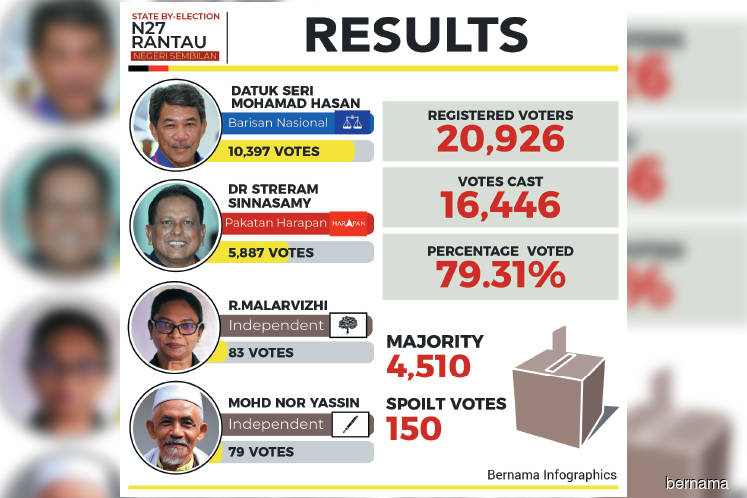
And in Tok Mat, who conquered virtually all of Rantau’s voting districts to give him a 4,510 majority over Pakatan Harapan’s (PH) Dr S. Streram, BN has a promising prospect.
 
“In Malaysian politics and power relations among competing multi-ethnic parties and interests, being moderate is a vital principle,” Kartini Aboo Talib, political scientist with Universiti Kebangsaan Malaysia, said.
“BN has to give him that opportunity. If his voters in his constituency believe that he has done an excellent job to deserve a second term, I am pretty sure he has the potential.”
Touted as a genuine moderate by party leaders, Tok Mat is seen as a grounded politician with a keen sense of diplomacy.
His sharp understanding of ground sentiment makes him especially endearing to the lower income group, a quality he fostered during his three-term rule as mentri besar.
“My team was on the ground observing Rantau and the minority voters really like him a lot,” Kartini noted.
“He has helped them in so many ways, especially small and medium enterprises.”
In Saturday’s by-election, Tok Mat won all the multi-racial districts bar one, a testament to the politician’s popularity in Rantau, a semi-urban state constituency with predominantly low-income voters.
BN swept 13 of the polling districts including Pekan Sagga (63.7 per cent Indians) and Linsum (48.3 per cent Indians) home to the highest and second highest proportion of Indian voters in Rantau.
Universiti Sains Malaysia’s Sivamurugan Pandian said the results cemented Mohamad’s stature as a highly popular leader with all races.
“As acting president with a big majority, he wins moral and political legitimacy in a mixed constituency,” he told Malay Mail.
“He could be the leader BN is looking for given the current political scenario.”
But still, the ‘Tok Mat factor’ failed to give BN the much-needed impetus to break PH’s sway over most of Rantau’s Chinese voters.
Bandar Ekar, which has the highest count of Chinese voters and third highest for Indian voters, remained firmly behind the ruling coalition.
Tok Mat’s inability to persuade the Chinese in Rantau provides a peek into the tough challenges awaiting his chairmanship and the BN coalition should it wish to stay on the moderate path, rebuild minority trust and be seen as a genuinely multi-racial front.
More immediately, the acting Umno president must first mollify Chinese suspicions of PAS and convince the community that their alliance will not result in more religious dogmatism or ethnic strife.
But with Umno deemed to have veered too far to the right in recent years, and its refusal to banish scandal-ridden leaders like former prime minister Datuk Seri Najib Razak, that could be difficult for Tok Mat to pull off despite his popularity.
“BN’s moderate image is difficult to be bandied about as far as non-Malays are concerned,” said Oh Ei Sun, a senior fellow at the Singapore Institute of International Affairs.
“As long as Najib still looms large on the front stage, and when Umno is embracing PAS tightly.”
And critics will also watch closely how the acting Umno president deals with the party’s ultra-Malay elements, which have grown more influential since its defeat last year.
As analysts see the party growing more beholden to staunch conservatives, detractors will ask if he will have the political courage to keep Umno in the centre amid the pressure.
Malay support for Tok Mat surged to 2013 levels in Saturday’s polls, as BN recovered most, if not all of the ground lost in the 14th general election, noted Ibrahim Suffian, director of pollster Merdeka Center.
Votes were likely cast along racial lines, Ibrahim added, suggesting non-partisan Malays had backed Tok Mat only because of his ethnicity.
“Ethnic voting probably played some role here, aside from Mohamad Hasan’s outsized following among voters there, the results showed PH probably captured only 10 per cent of the Malay voters there,” he said.
 

'Rantau Polls An Expected Outcome', The Edge, 15 April 2019

Rantau polls an expected outcome


This article first appeared in The Edge Financial Daily, on April 15, 2019.
-A +A
KUALA LUMPUR: According to a Malaysiakini report, a fight erupted among party campaigners at the Pakatan Harapan’s command centre when it was getting clear that Pakatan’s candidate would lose the Rantau by-election on Saturday.
The fight followed the blame game as the campaigners were obviously bitterly disappointed with the loss. And obviously also they really believed Dr S Streram could pull it off.
But he could not deliver the win that Pakatan needed so that it would not be the third straight loss in a by-election for the ruling coalition.
A Survey by The Edge Malaysia
So, was Pakatan and PKR in particular, wrong in choosing the good doctor to contest Rantau, although he had a good track record, having done voluntary relief work in war zones in several parts of the world? No. As I wrote in an earlier article, Streram deserved a second bite at the cherry after being denied the chance to contest in the Rantau constituency in the 14th general election (GE14) last year.
As we know, Streram was unable to submit his nomination papers after being denied entry into the nomination centre because he did not have a pass issued by the Election Commission.
Second question — Would Pakatan have won had another candidate been fielded? Again I must say No. No matter who that candidate might be, and no matter what the race, religion or gender.
The reality is Barisan Nasional Nasional’s (BN) Datuk Seri Mohamad Hasan was always going to win the seat. He’s been the Rantau Yang Berhormat from GE11 back in 2004. And he was Negeri Sembilan’s menteri besar right up to the point when BN lost the state in last year’s national polls.
Therefore his victory was no surprise, but was expected by many.
Research outfit Ilham Centre chief executive officer Azlan Zainal and political analyst Dr Sivamurugan Pandian both agree the “Tok Mat factor” — referring to the name Mohamad Hasan is popularly known as — played a big role in BN securing Rantau.
Siva says Tok Mat’s aura outshined his opponent while Azlan opines that the personal attacks on Mohamad backfired.
During campaigning, Pakatan had often reminded Rantau voters of the case of Mohamad transferring a large amount of money overseas using the services of a money changer and also about a house he is said to own valued at millions of ringgit.
Mohamad went to some great lengths to counter the onslaught. He need not have actually, as to most people in Rantau he could do no wrong.
The Pakatan strategy was for Streram to win enough Malay votes to add on to very solid Indian support and he would be home and dry.
That did not happen, and even the Indian votes were split.
According to Azlan, Pakatan was not successful in penetrating the Malay base and did not get the solid Indian support either.
Even the Anwar factor, says Azlan, could not help the Pakatan cause in Rantau despite the PKR president trying hard to woo Malays to vote for Steram.
To Siva, a lot of soul-searching is in order as Anwar was practically camped in Rantau.
Moments after the by-election result was announced, Datuk Seri Anwar Ibrahim responded by saying the defeat “is a reminder for Pakatan to focus on the people’s plight”.
In Rantau, the Pakatan focus was on issues that had already been played up during GE14, according to both Siva and Azlan.
Another factor according to Azlan was that the internal problems within Pakatan have not been resolved.
He sees the Pakatan machinery as disjointed with the component parties moving separately, on their own instead of operating as one effective and cohesive unit.
Siva describes the Pakatan machinery as weak.
Other factors contributing to the defeat, according to Siva, include the ineffectiveness of the state administration and bread-and-butter issues.
And of course Umno and Pas have been continuously fanning the “bangsa dan agama” sentiments to the hilt. Divisive as the ploy may be, it has worked thus far for the opposition, with a good number of Malays being taken up by the rhetorics.
Having said that, it would be good to note that the number of votes Mohamad won in the by-election as compared to the votes he got in the GE13 in 2013.
In Saturday’s by-election he got 10,397 votes while Streram got 5,887. In GE13 Mohamad won Rantau with 10,126 votes. His opponent then was Aisah Lamsah. Aisah, like Streram, was from PKR, and she obtained 5,513 votes.
Draw your own conclusions but it looks like BN, in particular Mohamad, and PKR, via two different candidates, did not gain or lose drastically — going by the number of votes. Sort of maintaining the status quo?
Azlan has come up with a long list of factors on what went wrong for Pakatan and why. I would say the whys he listed and also the reasons cited by Siva as the cause of the Pakatan’s loss are identical to the reasons they cited when Pakatan lost the Cameron Highlands and Semenyih by-elections.
These are the same reasons I had discussed in my earlier articles on Pakatan’s losses in Cameron Highlands and Semenyih, apart from the Tok Mat factor as stated earlier.
I am sure Pakatan too through its think tanks and strategic analysts knows all too well the reasons for their defeats. After all after each defeat they admitted it was a wake-up call.
Hence I can only conclude that either Pakatan has not learned its lessons or they have learned them but are sluggish and have not acted upon the lessons learnt, that is to rectify the situation and overcome the weaknesses — until now.
And I say this, despite acknowledging the fact that Pakatan has a lot on their plate, to clear the leftovers — courtesy of the previous administration.

Mohsin Abdullah is a contributing editor at The Edge. He has covered politics for more than four decades.

'Khabar Angin Tidak Gugat Ahmad Faizal Sebagai MB', Berita Harian, 15 April 2019


'Perak MB: I Will Not Lose Focus', New Straits Times, 15 April 2019


Thursday, April 04, 2019

'Rantau by-election: Litmus test for Anwar', New Straits Times, 4 April 2019


PKR president Datuk Seri Dr Anwar Ibrahim and Pakatan Harapan Rantau by-election candidate Dr S. Streram look on during a ceramah in Taman Angsamas, Rantau. -NSTP/ADZLAN SIDEK
SEREMBAN: With 10 days to go before polling day, the Rantau by-election is shaping up to be a battle between two political heavyweights — Barisan Nasional’s Datuk Seri Mohamad Hasan and Datuk Seri Anwar Ibrahim of Pakatan Harapan.

PKR’s Dr S. Streram may be contesting under the PH ticket, but it is clear that it is Anwar, not Dr Streram, who Mohamad has to be wary of.
 
The Anwar factor is playing an increasingly important role in this polls, which neither the BN deputy chairman nor the PKR president could afford to lose.

Dr Streram’s hustings, or ceramah kelompok as the PH election machinery calls them, had been low-key affairs that attract small groups of constituents.

But Anwar, who hit the campaign trail and stumped on behalf of Dr Streram for the first time on Tuesday, held three ceramah in one night and drew larger crowds of between 300 and 400 people.

In all three ceramah, Anwar spent a substantial amount of time explaining why he fielded Dr Streram, instead of a Malay, in the by-election, which is being held in a Malay-majority seat.

Dr Streram’s candidacy had not been well received by certain factions in PKR, who attributed BN’s recent electoral victories to Umno’s cooperation with Pas and the proliferation of Malay-Muslim sentiments.

Anwar went to great lengths to put his Malay audience at ease
by promoting Dr Streram’s humanitarian work in war-torn Muslim countries, like Sudan and Afghanistan.

But Dr Streram’s volunteerism will unlikely have any pull with the voters, who are mostly estate workers, working odd jobs and running small businesses. To them, it is bread-and-butter issues and the rising cost of living that matter the most.

In Rantau, Malays comprise 55.11 per cent, or 11,283 voters, Indians (5,336 voters) make up 26 per cent, Chinese (3,849 voters) make up 18.8 per cent and the remainder is made up of other races.

Pakatan Harapan and Barisan Nasional flags lined up along the main road in Rantau. -NSTP/SAIFULLIZAN TAMADI

The fact that Anwar is Port Dickson member of parliament explains his strong presence in Rantau, which is adjacent to his parliamentary constituency.

He went as far as promising that development projects in Port Dickson would have a spillover effect in Rantau, especially if Dr Streram won the polls.

“This is not a conditional promise. But I hope Dr Streram wins because at least I have someone I can work with,” Anwar said during a ceramah in Taman Sri Ramai here.
PKR has won three by-elections it contested since the 14th General Election (Seri Setia, Sungai Kandis and Port Dickson), but this is the party’s first by-election with Anwar at the helm.

PH, however, lost the last two polls in Cameron Highlands and Semenyih, and Anwar is facing mounting pressure not only to secure a win for the pact, but also break BN’s momentum from notching up a third win in a row.

“This will be Anwar’s first real test as the president of PKR. Mohamad is widely admired and hopes are pinned on him to rebuild Umno and BN in the aftermath of the 14th General Election,” said political analyst Professor Dr Sivamurugan Pandian of Universiti Sains Malaysia.

A win against the acting Umno president, said Sivamurugan, would elevate Dr Streram’s status as a giant killer and give credence to Anwar’s legitimacy as the prime minister-in-waiting.

“This is a clash between the prospective eighth prime minister and BN’s potential prime minister-designate. As Anwar’s nemesis, Mohamad may use the result of this election as a yardstick to determine whether it’s viable to aim for the premiership,” he added.

The by-election is no longer simply a contest between BN and PH. Rather, it is a clash between two powerhouses, between two household personalities whose brands transcend party lines.

The by-election sees a four-cornered fight between Dr Streram, Mohamad and two independents, R. Malarvizhi and Mohd Nor Yassin.
 

Saturday, March 30, 2019

'All Geared Up For Rantau', New Straits Times, 30 March 2019


Election commission personnel making last preparations for the nomination day. NSTP/SAIFULLIZAN TAMADI.


RANTAU: Today is nomination day for the Rantau by-election, which will likely see a straight fight between Pakatan Harapan and Barisan Nasional.
 
Representing PH is PKR’s Dr S. Streram, the 60-year-old anaesthetist who grabbed headlines after he was denied entry into the nomination centre in the 14th General Election last year.
This led to acting Umno president and three-term Rantau assemblyman Datuk Seri Mohamad Hasan winning the seat uncontested, but the result was later nullified by the Election Court.
However, despite having a second shot at contesting, Dr Streram, who is Rembau PKR deputy chief, will face an uphill battle as the underdog in this David and Goliath contest.
Mohamad, or Tok Mat as he is fondly known, is tipped to score a comfortable win.
He is a household name on his home turf, an impregnable fortress that has remained under BN since 1964.
PH currently controls 20 of the 36 seats in the Negri Sembilan assembly, and a win for either party will not affect the status quo.
However, victory in this semi-urban, Malay-majority state seat could prove pivotal for both sides.
BN is looking to score a trifecta win to consolidate its political legitimacy, while PH is keen to take down the head honcho of BN, who is credited with salvaging the alliance between Umno, MCA and MIC.
Mohamad, a businessman-turned-politician who served as Negri Sembilan mentri besar from 2004 until May last year, can ill afford a loss in Rantau.
In the event of a win, Umno’s succession plan will stay on course and Mohamad will be in pole position to become the next party president, replacing Datuk Seri Dr Ahmad Zahid Hamidi.
Universiti Sains Malaysia political analyst Professor Dr P. Sivamurugan said: “Tok Mat must continue the Cameron Highlands and Semenyih momentum, beside strengthening his position as Umno deputy president and acting president.
“As Rantau is a 53 per cent Malay and 48 per cent non-Malay constituency, his track record and aura as a leader will be tested, too.”
While some claim PH stands a better chance of winning by fielding a Malay candidate, its current strategy could pay off if a relative lightweight like Dr Streram manages to notch up a win against Tok Mat.
“PH, especially PKR, wants to avoid the prospect of three consecutive losses to BN.
“It is the first real test for Datuk Seri Anwar Ibrahim as PKR president,” said Sivamurugan.
Anwar, who recently won the Port Dickson parliamentary by-election, is hoping voters will reject any manipulation of racial sentiments in Rantau, especially after the “marriage” between Umno and Pas.
Dr Streram was picked by Anwar and PKR based on his work background and contributions as a volunteer doctor in war-torn Muslim countries.
But it is unclear whether Dr Streram’s tour of duty with Doctors Without Borders in Afghanistan and Sudan will translate into votes.
The one advantage Dr Streram has over his opponent is the backing and support he will receive from the PH-led state and the federal government.
Anwar will likely hit the campaign trail and stump for his candidate. A win in Rantau will not only be symbolic for the prime minister-in-waiting, but also bear testament to his leadership.
Regardless, observers say Dr Streram deserves a second chance as he took the initiative to challenge Mohamad’s uncontested win in court.
And Sivamurugan says Dr Streram may canvass support and “fish for sympathy votes” from the Indian community, who he dubs as the kingmaker in this polls.
Out of the 20,472 registered voters, 53 per cent are Malays while 27 per cent are Indians. The Chinese make up about 18 per cent of the electorate.

Blog Archive